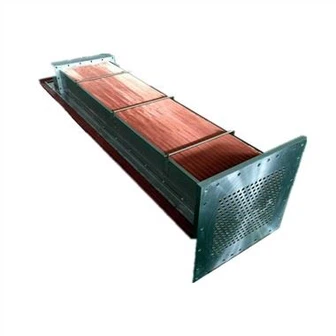
Shell And Tube Heat Exchanger For Heating And Cooling
The shell-and-tube heat exchanger customized by Vrcooler according to the customer's requirements has been painted and ready to be packed and sent to France.
Shell and tube heat exchangers are also called shell and tube heat exchangers. It is a partitioned wall heat exchanger that uses the wall of the tube bundle enclosed in the shell as the heat transfer surface. This kind of heat exchanger has a relatively simple structure and reliable operation. It can be made of various structural materials (mainly metal materials), and can be used under high temperature and high pressure. It is the most widely used type at present.


Factors to consider in the design of shell and tube heat exchangers
There are many types of heat exchange equipment. For each specific heat transfer condition, the most suitable equipment model will be obtained through optimal selection. If this type of equipment is used in other conditions, the heat transfer effect may be improved. big change. Therefore, it is very important and complicated work to select the type of heat exchanger for specific working conditions. For the design of shell and tube heat exchangers, the following factors are worth considering:
1. Selection of flow rate
Flow rate is an important variable in heat exchanger design. Increasing the flow rate will increase the heat transfer coefficient, and at the same time, the pressure drop and power consumption will also increase. If pumping fluid is used, it should be considered that the pressure drop should be consumed as much as possible on the heat exchanger instead of On the regulating valve, this can improve the heat transfer effect by increasing the flow rate.
Using a higher flow rate has two advantages: one is to increase the overall heat transfer coefficient, thereby reducing the heat transfer area; the other is to reduce the possibility of fouling on the tube surface. But it also correspondingly increases the consumption of resistance and power, so it is necessary to make an economic comparison to finally determine the appropriate flow rate.
2. Allowable pressure drop selection
Choosing a larger pressure drop can increase the flow rate, thereby enhancing the heat transfer effect and reducing the heat transfer area. But the larger pressure drop also increases the operating costs of the pump. The appropriate pressure drop value needs to be calculated based on the total annual cost of the heat exchanger, repeated adjustments to the size of the equipment, and optimization calculations.
In most devices, it may be found that the thermal resistance on one side is significantly higher than the other side, and the thermal resistance on this side becomes the controlling thermal resistance. When the thermal resistance of the shell side is the control side, the method of increasing the number of baffle plates or reducing the shell diameter can be used to increase the fluid flow rate on the shell side and reduce the heat transfer resistance, but there is a limit to reducing the spacing of the baffle plates. Cannot be less than 1/5 or 50mm of shell diameter. When the thermal resistance of the tube side is the control side, the fluid flow rate is increased by increasing the tube maturity.
When dealing with viscous materials, if the fluid is in laminar flow, the material will go to the shell side. Since the fluid flow on the shell side tends to be turbulent, this results in higher heat transfer rates and improved control of pressure drop.
3. Determination of shell-side fluid
It is mainly based on the operating pressure and temperature of the fluid, the available pressure drop, structure and corrosion characteristics, and the selection of required equipment and materials to consider which way the fluid is suitable for. The following factors are available for consideration when selecting:
The fluids suitable for the tube pass include water and water vapor or strong corrosive fluids; toxic fluids; fluids that are easy to structure; fluids that operate at high temperature or high pressure, etc.
Fluids suitable for the shell side include condensation of overhead distillate; condensation and reboiling of hydrocarbons; fluids controlled by pressure drop of pipe fittings; fluids with high viscosity, etc.
When the above situation is eliminated, the choice of which path the medium takes should focus on improving the heat transfer coefficient and making the most of the pressure drop. Since the flow of the medium on the shell side is easy to reach turbulent flow (Re≥100), it is generally beneficial to move the fluid with high viscosity or low flow rate, that is, the fluid with low Reynolds number, to the shell side. Conversely, if the fluid can reach turbulent flow in the tube, it is more reasonable to arrange to go through the tube. From the point of view of pressure drop, generally the shell run with low Reynolds number is reasonable.
4. Determination of final heat transfer temperature
The final heat exchange temperature is generally determined by the needs of the process. When the final heat exchange temperature can be selected, its value has a great influence on whether the heat exchanger is economical and reasonable. When the outlet temperature of the hot fluid is equal to the outlet temperature of the cold fluid, the heat utilization efficiency is the highest, but the effective heat transfer temperature difference is the smallest and the heat exchange area is the largest.
In addition, when determining the outlet temperature of the stream, it is not desirable to have a temperature cross phenomenon, that is, the outlet temperature of the hot fluid is lower than the outlet temperature of the cold fluid.
5. Selection of equipment structure
For certain process conditions, the form of equipment should be determined first, such as choosing a fixed tube sheet form or a floating head form, etc.
In the heat exchanger design process, the general goals of heat transfer enhancement are summarized as follows: reduce the size of the heat exchanger under a given heat transfer; improve the performance of the existing heat exchanger; reduce the temperature difference of the flowing working fluid; or reduce pump power.
The heat transfer process refers to the process of heat exchange between two fluids through the wall of a hard device. According to the heat transfer method of the fluid, it can basically be divided into two types: no phase change and phase change. The research on enhanced heat transfer technology without phase change process generally takes corresponding measures based on controlling the thermal resistance side: such as expanding the inner or outer surface of the tube; inserting foreign objects in the tube; changing the form of the tube bundle support; adding immiscible low boiling point additives and other methods to enhance the heat transfer effect.